
A closer starts leaking, a push bar sticks, a lock cylinder turns rough and the question is always the same. Fix it, or pull the whole unit?
Getting replace vs repair door hardware right on commercial entrances comes down to three numbers: the age of the component, the repair cost against replacement, and how many cycles the opening sees per day. We make this call across the GTA every week, and the wrong answer costs more in callbacks than it ever saved upfront.
Cost Comparison: Repair vs Replace
These are the ranges we quote in Toronto, parts and labour included. Use them as a decision baseline, not a fixed price — frame condition and access change the figure.
| Hardware Component | Repair Cost | Replacement Cost | Recommended Action |
| Door closer | $120–$280 | $200–$450 | Repair if under 7 years old |
| Push bar / panic device | $150–$350 | $300–$800 | Repair for mechanism issues |
| Hinges (per set) | $80–$180 | $120–$300 | Replace if worn beyond 50% |
| Lock cylinder | $90–$200 | $150–$350 | Repair unless security upgrade needed |
| Automatic door operator | $200–$600 | $1,200–$3,500 | Repair if motor and sensors work |
One rule cuts through most of this: when repair reaches 60% of replacement cost, replace. Below that line, repair is almost always the better spend.
When Repairing Door Hardware Makes Sense
We repair when the core mechanism is sound and the fault is isolated to one part. That covers more situations than most building managers expect.
Repair is the right call for:
- Door closers with hydraulic leaks or drift — seals, valves, and arms are serviceable parts. Our commercial door closer repair work regularly restores closers that were quoted for replacement elsewhere.
- Push bars with sticky latches or dogging faults — the latch assembly is often the only failed component. See our commercial door push bar repair service for what is serviceable on a panic device.
- Hinges with worn pins but sound leaves — pins and bearings replace cheaply, and hinge repair and replacement prevents the sag that damages frames later.
- Automatic doors needing sensor calibration or belt replacement — the operator itself is untouched. Most faults we handle on automatic door systems are peripheral, not structural.
Age matters as much as symptom. Hardware under five years old, still inside manufacturer warranty, should almost always be repaired. Replacing a warrantied component means paying for something the manufacturer would have covered.
When Replacing Door Hardware Is the Better Decision
Replacement wins when the component has reached end-of-life or has already been patched more than twice. We see hardware that has been repaired three times in two years — at that point the repairs have quietly cost more than a new unit.
Replace when:
- Repair approaches 60% of replacement cost. The remaining service life does not justify the gap.
- The unit is obsolete. Automatic operators over twelve years old have discontinued control boards and scarce parts. A repair that waits four weeks for a board is not a repair.
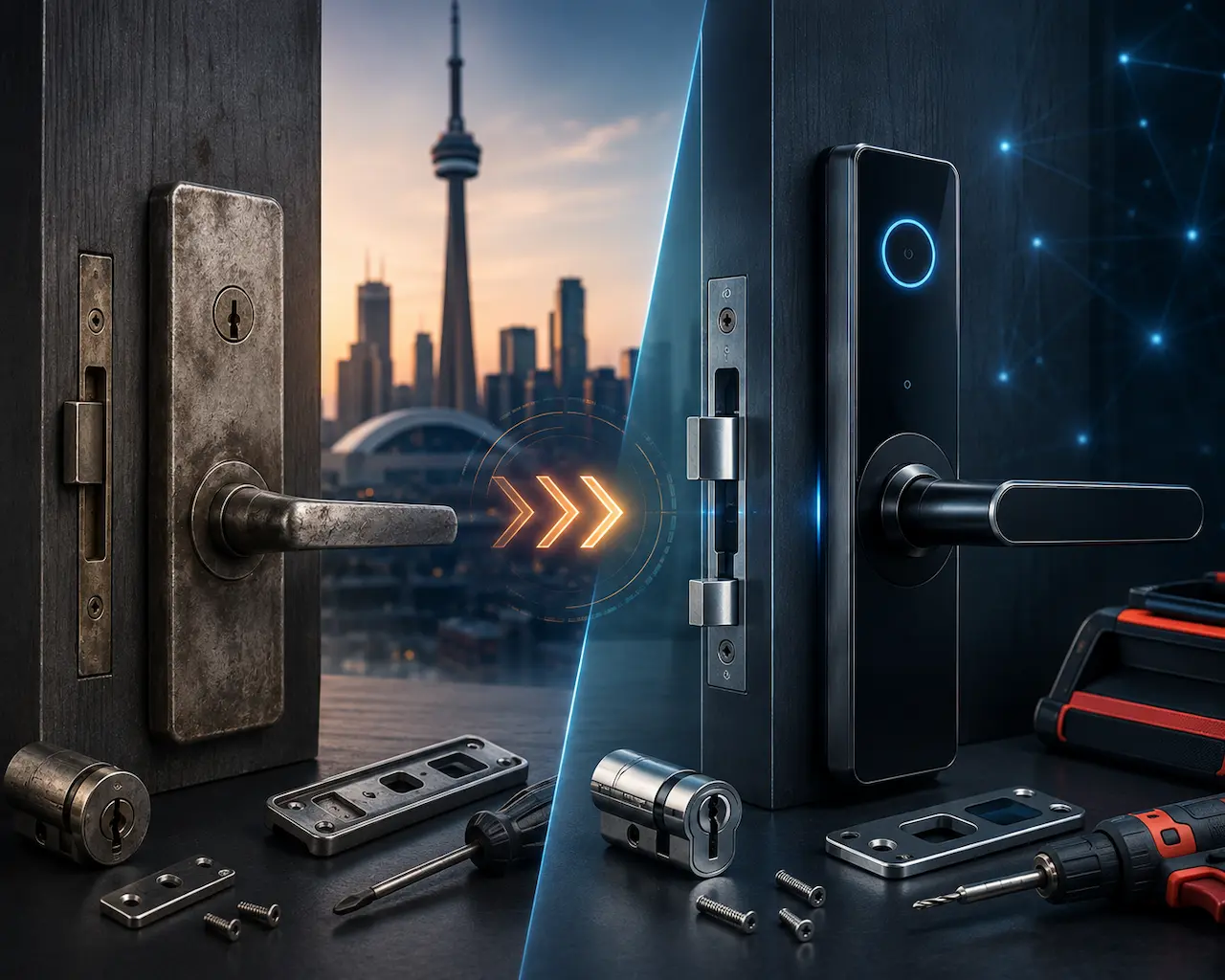
- The building is upgrading security or access control. Retrofitting old hardware to accept electrified strikes and card readers usually costs more than replacing the set outright.
- The grade is wrong for the traffic. Grade 2 hardware fitted to a high-cycle entrance will keep failing regardless of how well it is repaired. Exterior commercial entrances need ANSI/BHMA Grade 1.
Fire-rated openings sit in their own category. Substituting non-listed hardware on a labelled assembly voids the certification under NFPA 80, which Ontario fire safety requirements reference. Our fire rated doors team specifies listed components so the assembly stays compliant at annual inspection.
Signs Your Hardware Needs Professional Assessment
Some faults look cosmetic and are structural. These warrant an inspection before you decide anything:
- A closer that slams shut or fails to latch on its own
- A push bar that does not fully retract after each use
- Hinges backing out of the frame, or a door that has visibly dropped
- Erratic operation, unusual noise, or safety sensor faults on automatic doors
- Repeated failures of the same component within twelve months
That last one usually means the hardware is not the problem. When a closer fails twice in a year, the frame is normally out of alignment and the closer is absorbing the misalignment. Fixing the hardware alone guarantees a third failure — the same pattern we cover in our guide to reinforcing commercial door frames.
When We’re Not Your Best Option
We would rather say this plainly than take a job that does not help you.
If your hardware is under manufacturer warranty and the original installer is still trading, go to them first. They will handle the warranty claim at no cost and know the specific system better than any third party.
If the issue is purely cosmetic — a scratched push bar cover, a faded label, a loose escutcheon — you can handle that in-house. We are not cost-effective on problems that do not affect function or safety.
Making the Financial Decision
Immediate cost is the wrong number to optimise. Total cost of ownership over three years is the right one.
A $300 repair on ten-year-old hardware looks sensible until you count the two additional failures likely within twenty-four months, plus the emergency call-out rates attached to them. Three service visits at emergency pricing exceed a single planned replacement almost every time.
Downtime carries its own cost on high-traffic entrances. A retail or medical entrance that cannot secure at close means staff waiting on site, and in some cases an unsecured premises overnight.
Building lifecycle timing also matters. If major renovations are eighteen months out, targeted repairs to bridge the gap make sense. If the entrance is staying as-is for a decade, invest in Grade 1 hardware and stop paying for the same fault repeatedly.
Why Choose Us
We have serviced commercial door hardware across Toronto, Mississauga, Brampton, and the wider GTA since 2009, and we quote the option that costs you less over three years, not the one that bills higher today.
- AAADM-certified, WSIB-covered technicians with 17 years of commercial experience
- Repair-first assessment with a written comparison before any work begins
- Grade 1 hardware specified to manufacturer and Ontario Building Code standards
- Fire-rated openings serviced without voiding the assembly listing
- Same-day and emergency response across the GTA
Conclusion
The replace vs repair door hardware decision is settled by three things: component age, repair cost against the 60% threshold, and daily cycle count. Under warranty and isolated fault means repair. Obsolete, repeatedly patched, or wrong grade for the traffic means replace. If you are unsure which side your hardware falls on, call us at (647) 477-0557 or request a quote for an on-site assessment.
Frequently Asked Questions
How long should commercial door hardware last before replacement?
Quality closers and hinges run 10–15 years with maintenance. Push bars and lock cylinders typically last 8–12 years. Automatic door operators need replacement every 10–12 years, driven more by parts availability and technology than by mechanical wear.
Can I mix brands when replacing hardware components?
For mechanical parts like hinges and closers, yes. For automatic door systems and integrated access control, stay within one manufacturer family — mixed electronics create compatibility gaps and can void warranty coverage on both sides.
Is it worth repairing hardware on doors I plan to replace soon?
If replacement is within six months, minimal repairs to maintain safe function are the right spend. Beyond that window, repair properly. A door awaiting replacement still has to latch and still has to meet exit requirements. Our guide on when to repair vs replace a commercial door covers the full timing decision.
How long does a door hardware repair last?
Repairs using genuine manufacturer parts typically hold 2–5 years depending on cycle volume. Aftermarket or temporary fixes often last only 6–18 months. Always ask what parts are being fitted and what warranty covers the labour.
Should I upgrade to newer technology when replacing old hardware?
Only if you need what it offers. Like-for-like replacement is fine when your current setup meets requirements and budget is tight. Newer automatic systems justify the cost when you need improved safety sensing, better energy performance, or access control integration. Our commercial door hardware team can price both options side by side.