
Most forced entries do not defeat the lock. They defeat the frame around it. A hardened cylinder means nothing when the jamb splits at the strike and the latch pulls straight through the steel.
We repair and reinforce commercial door frames across Toronto every week, and the failure point is almost always the same three inches of metal beside the latch. This guide covers what actually holds, what does not, and where Toronto buildings lose their security.
Why Commercial Door Frames Fail Before the Door Does
A commercial entrance is a system: door, frame, hinges, strike, and anchors. Security is capped by the weakest of the five, and that is rarely the door slab.
Three failure patterns cause the majority of the frame work we handle:
- Under-gauge steel. Many older Toronto storefronts were fitted with 18-gauge hollow metal frames intended for interior partitions. Exterior openings need 16-gauge minimum, and high-traffic or high-risk entries need 14-gauge.
- Screws that grip nothing. Factory strike plates ship with 3/4-inch screws that bite only the frame skin. Under a spread bar, they tear out at loads a determined person can produce in under a minute.
- Corrosion at the sill. Road salt and freeze-thaw cycling attack the bottom six inches of the jamb. By the time rust shows on the surface, the anchor pocket behind it is often already gone.
Toronto’s temperature swing makes this worse than in milder markets. Steel expands and contracts through a range of more than 60 degrees between January and July, working anchors loose and opening gaps between the frame and the surrounding wall. Once that gap exists, the frame flexes — and a frame that flexes cannot hold a latch.
Warning Signs Your Commercial Door Frame Needs Reinforcement
Frame failure announces itself long before a break-in. We tell every client to watch for these:
- A visible gap between the door edge and the jamb wide enough to pass a fingertip
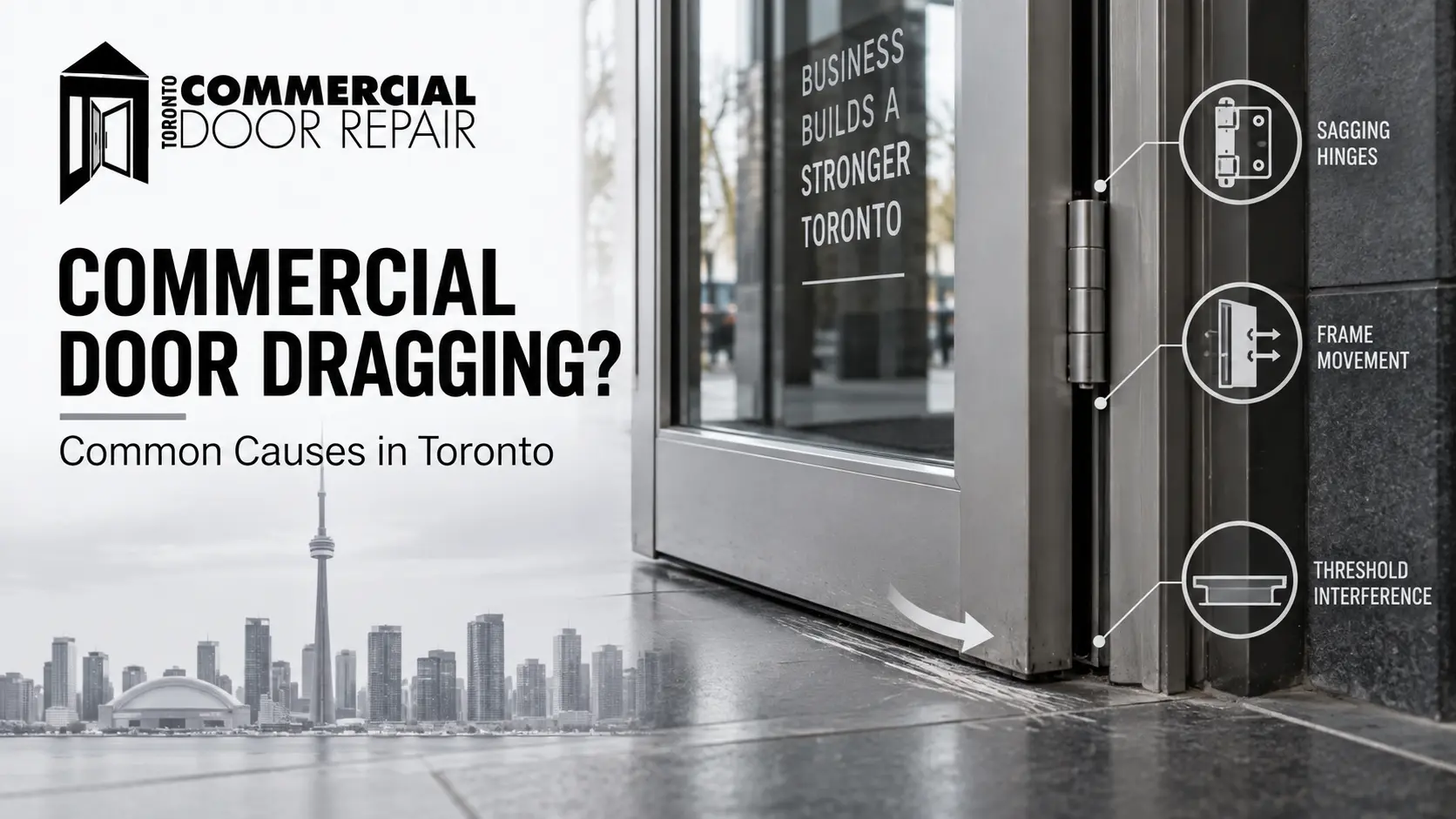
- The door dragging, sticking, or needing a shoulder to latch
- Hinge screws backing out, or hinge leaves no longer sitting flush
- Daylight at the head or sill of an exterior opening
- Previous pry damage that was filled and painted rather than repaired
- Rust bubbling at the bottom of the jamb, or a soft spot when pressed
Any one of these means the frame is no longer transferring load into the building structure. That is the point to act, not after an incident.
How to Reinforce Commercial Door Frames: Six Proven Methods
These are the methods we specify on real openings, in the order they deliver value.
1. Wrap-Around Strike Reinforcement
A steel wrap-around plate wraps the latch edge of the frame and distributes prying force across a much larger area than a flat strike. This is the single highest-return upgrade on almost every opening we assess.
2. Long-Screw Anchoring at the Strike
We replace every strike screw with 3-inch fasteners driven through the frame and into the structural stud or masonry behind it. The load then transfers into the wall instead of the frame skin. It costs almost nothing and changes the failure threshold dramatically.
3. Box Strikes with Full Latch Capture
A surface strike catches the latch edge. A box strike captures the entire bolt throw inside a steel pocket. Paired with a one-inch deadbolt throw, the latch must be sheared rather than levered out.
4. Continuous Hinges on High-Cycle Openings
Standard butt hinges concentrate the door’s weight at three points. A continuous geared hinge spreads that load down the full height of the jamb, which stops the sag that causes misalignment in the first place. On entries cycling several hundred times a day, this is preventative structure, not a repair. For openings already showing wear, our commercial door hinge repair and replacement service addresses the alignment before it becomes frame damage.
5. Re-Anchoring the Frame to the Structure
A reinforced frame anchored into drywall is still a weak opening. We re-anchor into masonry with sleeve or wedge anchors, and into steel stud with through-bolted connections, placing fixings near the head and sill and at roughly 24 to 30-inch intervals down each jamb.
6. Grouting and Welded Splice Repair
Grout-filling a hollow metal frame in masonry eliminates the void that lets the jamb deform under impact. Where the lower jamb has corroded through, we cut back to sound steel and weld in a matching-gauge splice rather than filling and painting over structural loss.
Frame Reinforcement Only Works If the Hardware Matches
A reinforced frame paired with builder-grade hardware produces a new weak point rather than a secure opening. We specify ANSI/BHMA Grade 1 locksets on reinforced exterior entries, because Grade 2 hardware is rated for lighter cycle counts and lower impact loads than a commercial entrance sees.
The same applies to closers and exit devices. A closer that slams the door drives the latch into a reinforced strike at speed and destroys alignment within months. Our commercial door closer repair work is regularly the difference between reinforcement that lasts a decade and reinforcement that fails in a year. Where panic hardware is fitted, the mounting points must be reinforced along with the strike — details we cover in our guide to commercial door hardware in Toronto.
Fire-Rated Frames Have Rules You Cannot Ignore
This is where well-intentioned reinforcement creates a code violation.
A fire-rated door assembly is certified as a complete unit. Drilling, welding, or field-modifying a labelled frame voids that certification, and NFPA 80 — referenced by Ontario fire safety requirements — prohibits unlisted modifications. Fire door assemblies also require documented annual inspection.
Reinforcement on a rated opening must use listed components installed to the manufacturer’s certification. If you are unsure whether an opening is rated, look for the metal label on the hinge edge of the frame. Our fire rated doors and commercial fire exit doors repair teams handle rated openings without breaking the listing. A failed fire door inspection carries real consequences: orders to comply, insurance complications, and in serious cases forced closure.
DIY Versus Professional Frame Reinforcement
One task on a commercial frame is genuinely safe to handle in-house. The rest are not, and the difference matters because bad reinforcement is harder to fix than no reinforcement.
Safe to do yourself:
- Replacing factory strike screws with 3-inch fasteners. Basic tools, no structural change, and it meaningfully raises the force needed to defeat the latch.
Leave to a technician:
- Fitting a wrap-around strike plate — the plate must sit square to the latch throw. Fitted a few millimetres off, it forces the door and accelerates the wear you were trying to stop.
- Re-anchoring a loose frame — the correct fixing depends entirely on what is behind the jamb. Masonry, steel stud, and hollow block each need a different anchor, and the wrong one gives a false sense of security.
- Welded jamb splice repair — hot work next to a fire separation, on steel that must stay dimensionally true through the weld. This needs certification and heat control.
- Any work on a labelled fire-rated frame — drilling or welding a certified assembly voids the listing and breaches code, regardless of how sound the repair looks.
The pattern is straightforward: fastening is fine, anything that changes the structure is not. We regularly see openings where a well-meant repair locked a misalignment in permanently, and correcting that costs more than the original job would have.
Emergency Frame Reinforcement Checklist
When a frame fails outside business hours:
- Stabilise the opening — temporary bracing, not a wedged door
- Take the opening out of service if it is an exit route, and post an alternate route
- Photograph the damage before anything is moved, for the insurance claim
- Call for emergency commercial door repair rather than boarding over a required exit
- Never chain or padlock a fire exit, even temporarily
Why Choose Us
We have reinforced commercial door frames across Toronto, Mississauga, Brampton, Markham, and the wider GTA since 2009, and we repair the cause rather than the symptom.
- AAADM-certified, WSIB-covered technicians with 17 years of commercial door experience
- Frame reinforcement completed to Ontario Building Code and manufacturer specifications
- Fire-rated openings handled without voiding the assembly listing
- Same-day and emergency response across the GTA
- Parts and labour warranty on every reinforcement job
Conclusion
Reinforcing commercial door frames is the cheapest security upgrade available to a Toronto business, and the most commonly skipped. Long screws, a wrap-around strike, and sound anchoring cost a fraction of a break-in claim. If your frame shows gaps, drag, or corrosion at the sill, it is already past the point of prevention. Call us at (647) 477-0557 or request a quote for an on-site assessment.
Frequently Asked Questions
How much does it cost to reinforce a commercial door frame in Toronto?
Most single openings fall between $400 and $1,200 depending on frame condition, wall construction, and hardware grade. Strike and anchor upgrades sit at the lower end. Welded jamb repair or a grouted frame sits at the upper end. Full replacement costs considerably more, which is why we assess reinforcement first.
Can you reinforce a fire-rated door frame?
Yes, but only with listed components installed to the certification. Field welding or drilling a labelled frame voids the rating. We verify the label before any work and document what was installed for your annual fire door inspection.
How long does commercial door frame reinforcement take?
Strike and anchor reinforcement on a single opening typically takes two to three hours. Welded jamb repair or a grouted frame usually takes most of a day and needs the opening out of service, so we schedule that outside trading hours where possible.
Do I need to replace the door when I reinforce the frame?
Usually not. If the slab is straight and the edges are sound, the frame is the correct place to spend. We cover the decision in detail in our guide on when to repair vs. replace a commercial door.
Can I reinforce a commercial door frame myself?
You can safely swap strike screws for 3-inch fasteners. Anything involving anchoring, welding, alignment, or a rated opening needs a qualified technician — improper work often locks in the misalignment that caused the failure.